The Enlightenment “rediscovery” of Ancient Greek civilization took shape in the mid-eighteenth century, initiating a debate regarding the respective merits of Ancient Greece and Rome that captivated intellectual circles in Rome.
German cultural historian Johann Joachim Winckelmann (1717–1768) spearheaded the Greek camp while Piranesi became the defender of Rome. Arguing for the superiority of Roman aesthetic traditions that he claimed were rooted in Etruscan precedent, Pirianesi replied directly to Winckelmann and other Hellenists like Julien-David Le Roy (French, 1724–1803) with his Della magnificenza ed architettura de’Romani [On the Magnificence and Architecture of the Romans] (1761).
Despite Piranesi’s efforts, the Greek side eventually won out, leading to the Greek Revival in architecture and a lasting perception of Ancient Greek artistic superiority that lingers to this day.
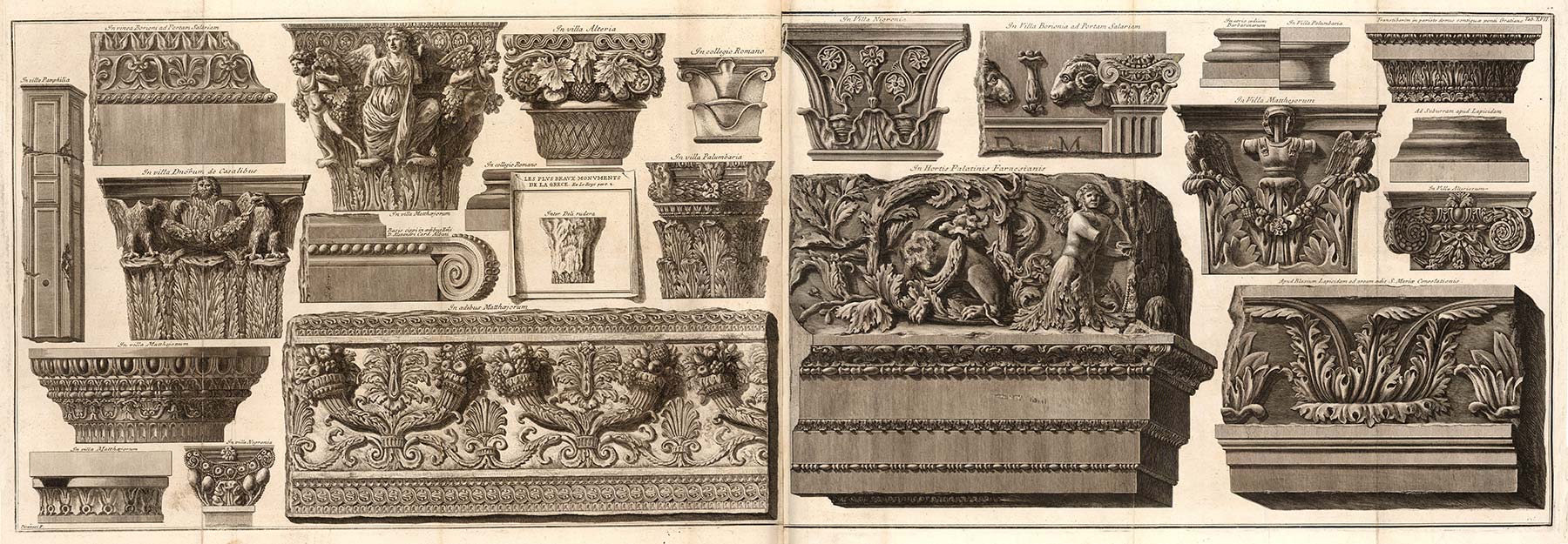
Della magnificenza ed architettura de’Romani [On the Grandeur and Architecture of the Romans], 1761
Etchings and engravings on paper
20 1/2 x 14 5/8 inches, extended 20 1/2 x 57 inches (52 x 37.1 cm, extended 52 x 144.7 cm)
Loan from Special Collections & Archives, Middlebury College
Gift of Michael Hassig ’74 and Chris Hassig ’09
Click or tap image to enlarge
In 1758 French architect Julien-David Le Roy published Les monuments les plus beaux de la Grèce [The Most Beautiful Monuments of Greece], declaring the superiority of Ancient Greek architecture. Piranesi responded with De Romanorum Magnificentia et Architectura [On the Grandeur and Architecture of the Romans], a large folio publication in Latin and Italian. Piranesi employed its grandiose title and its sizable fold-out plates as rhetorical devices to underscore the greatness of Ancient Roman architecture.
In this fold-out, Piranesi contrasts a paltry-looking Greek capital, included as a visual quotation from Le Roy’s publication, with a rich variety of Roman architectural ornaments.
Kyra Dybas ’28
Dominico Cunego
Italian, 1726–1803
With Giovanni Battista Piranesi
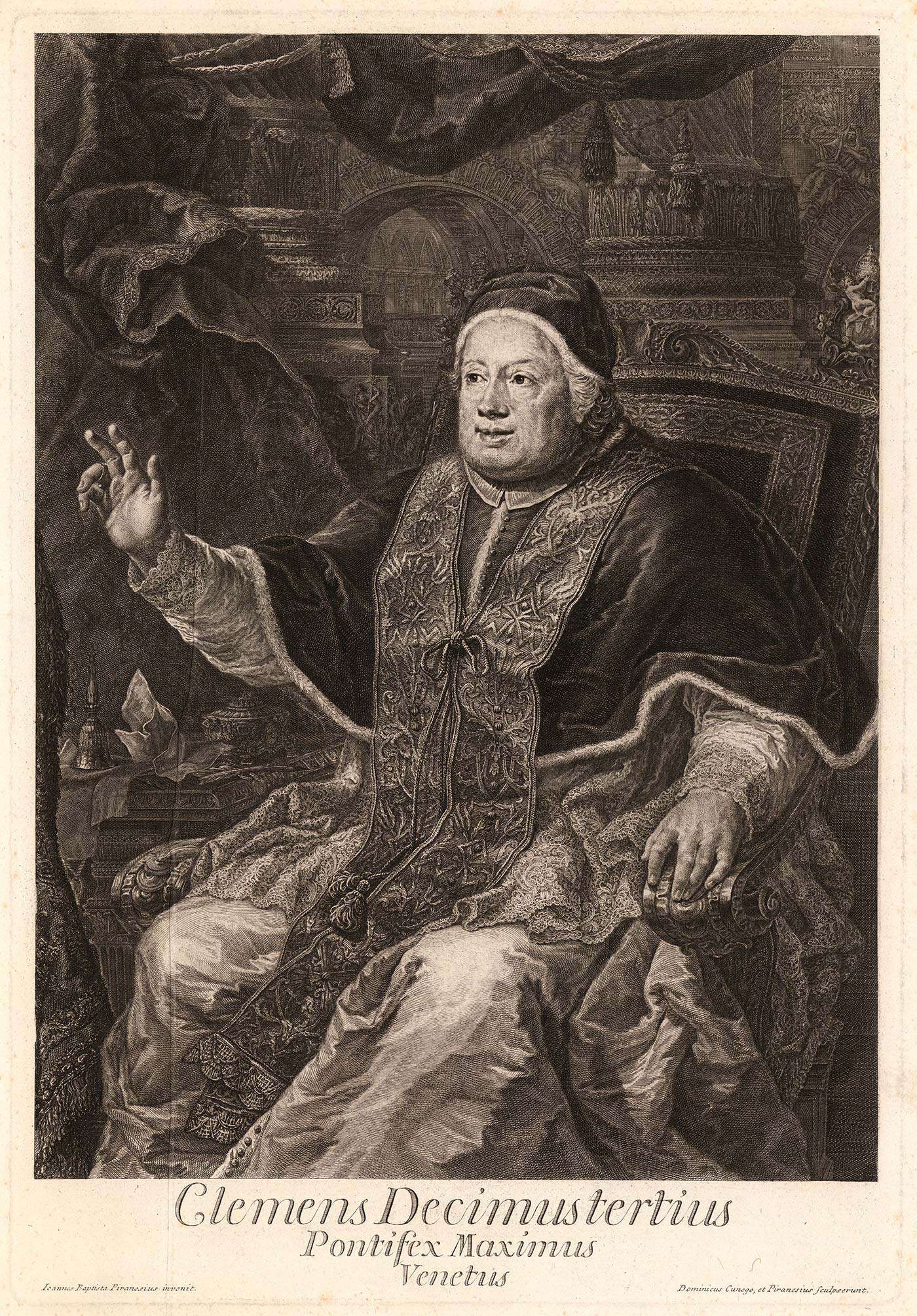
Clemens Decimustertius Pontifex Maximus Venetus [Clement XIII, pope from Venice], 1761
Frontispiece of Della magnificenza ed architettura de’Romani [On the Grandeur and Architecture of the Romans]
Etching on paper
Image: 19 1/8 x 13 3/16 inches (48.6 x 33.5 cm)
Loan from Special Collections & Archives, Middlebury College
Gift of Raphael and Jane Bernstein
Click or tap image to enlarge
Piranesi dedicated his momentous publication to Pope Clement XIII Rezzonico (Italian, 1693–1769). A fellow Venetian, he became an important patron of the artist, granting him a knighthood in 1767. Delighted, Piranesi signed his subsequent works as “Cavalier Piranesi.”
The pope’s affluence and authority emerges in this likeness created by Domenico Cunego. The dramatic curtain, however, guides the viewer towards the structures in the back, alluding to the book’s subject matter, the excellence of Roman architecture.
Sofia Marcktell ’27
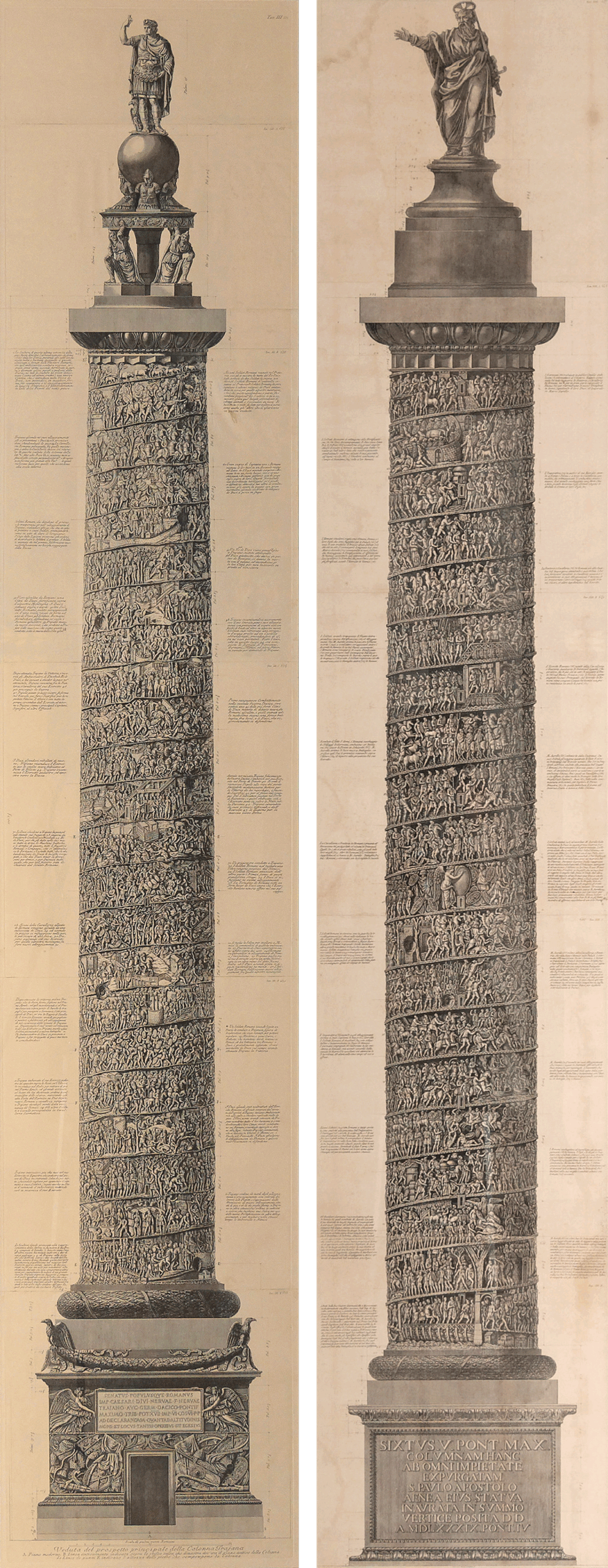
Veduta del prospetto principale della Colonna Trajana [View of the Main Elevation of Trajan’s Column], 1774–79
From Trofeo o sia magnifica colonna coclide … [Trophy or Magnificent Spiral Column …]
Etching on paper
Image: 106 x 18 3/4 inches (269.2 x 47.6 cm)
Gift of an anonymous donor, 0.126
Veduta del prospetto principale della Colonna Antonina [View of the Main Elevation of the Column of Marcus Aurelius], 1776–77
From Trofeo o sia magnifica colonna coclide … [Trophy or Magnificent Spiral Column …]
Etching on paper
Image: 101 x 18 1/2 inches (256.5 x 47 cm)
Gift of an anonymous donor, 0.127
Click or tap image to enlarge
Only two of Rome’s imperial columns have survived: those of Trajan (ruled 98–117 CE) and Marcus Aurelius (ruled 161–180 CE). Piranesi emphasized their monumental grandeur by representing them as gigantic prints.
The frieze on Trajan’s column depicts his Dacian campaigns. A statue of Trajan—replaced by one of Saint Peter in 1588—stands atop a pedestal of Piranesi’s invention. Marcus Aurelius’s column commemorates his Germanic campaigns. Here Piranesi depicts the statue of Saint Paul at its summit, also installed in 1588.
Relief stamps in the prints’ lower right corners indicate they were printed after 1870. The prints were acquired for Starr Library when it opened in 1900.
Tyler Pincelli ’28 and Farren Stainton ’28