Piranesi’s Carceri prints rank among his most important artistic output. They depict labyrinthine complexes with large staircases, monumental arches, vertiginous bridges, and props borrowed from scenic design, evoking a haunting atmosphere of confinement. The figures in the prints seem free to wonder but not to escape. As such, Piranesi’s Carceri prints have been considered an early expression of modern concerns.
In the series, first issued in 1749-50, Piranesi emphasized the vast spaces populated sparingly with hazy figures. In the expanded edition of c. 1761, he dramatically darkened the prints and added chains, gallows, and instruments of torture.
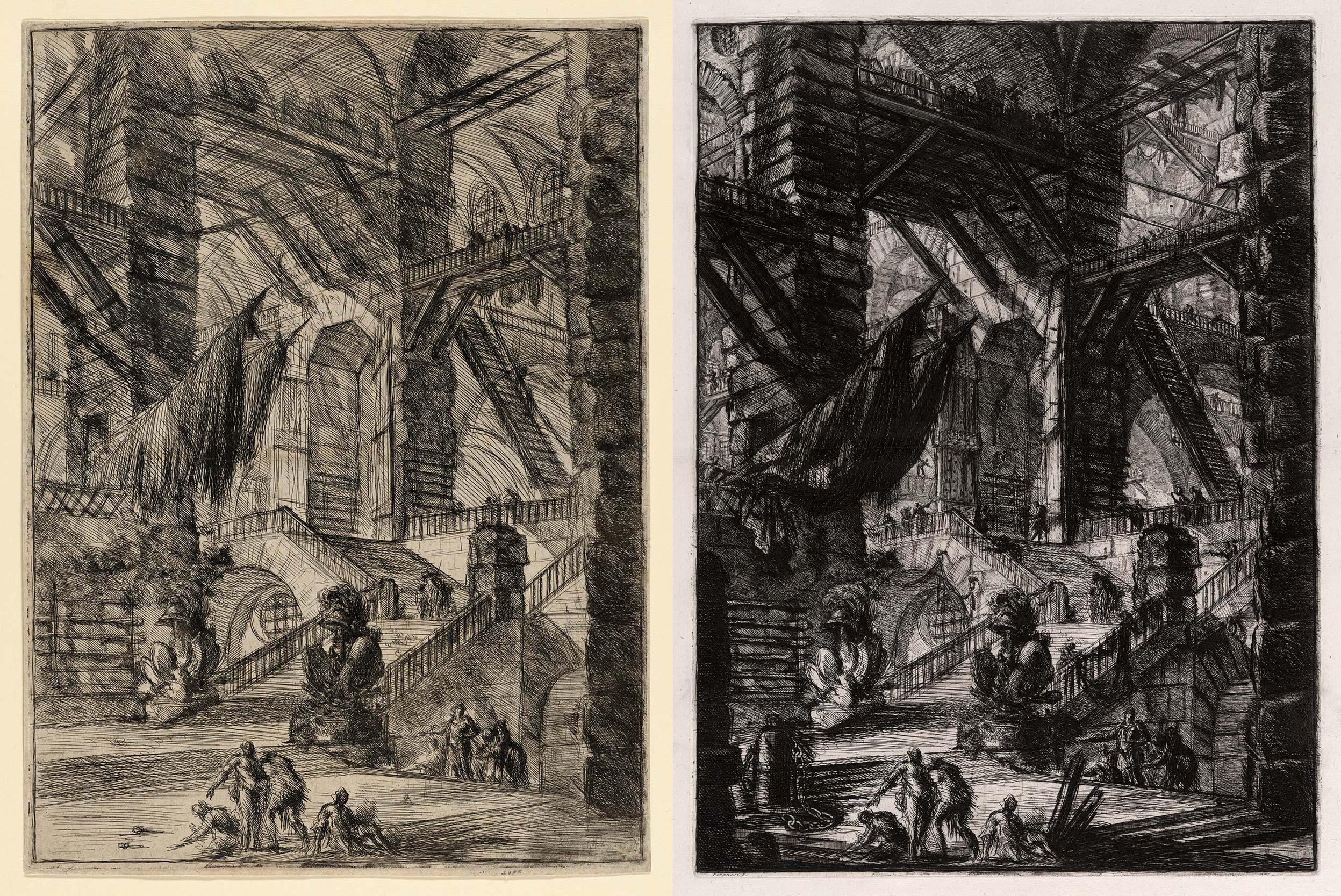
“The Staircase with Trophies”
Plate 8 from Carceri d’invenzione [Imaginary Prisons]
First edition, 1749–60
Etching and engraving on paper
Image: 21 1/2 x 15 7/8 inches (54.6 x 40.3 cm)
Loan from Yale University Art Gallery
Bequest of Ralph Kirkpatrick, Hon. M.A. 1965
“The Staircase with Trophies”
Plate 8 from Carceri d’invenzione [Imaginary Prisons]
Second edition, mid 1760s–early 1770s
Etching and engraving on paper
Image: 21 7/16 x 15 3/4 inches (54.5 x 40 cm)
Loan from Yale University Art Gallery
The Arthur Ross Collection
Click or tap image to enlarge
Piranesi made the first edition of this print in 1745, when he was in his twenties. The viewer gets lost in the seemingly endless space, a veritable three-dimensional labyrinth in which a zig-zag path leads upwards from the lower-right corner.
He reworked the plate in 1761, at age forty. For this second edition, he considerably darkened the image—and the mood. The result is a hallucinatory, haunting image into which Piranesi invites the viewer to explore this disquieting path.
Sofia Marcktell ’27
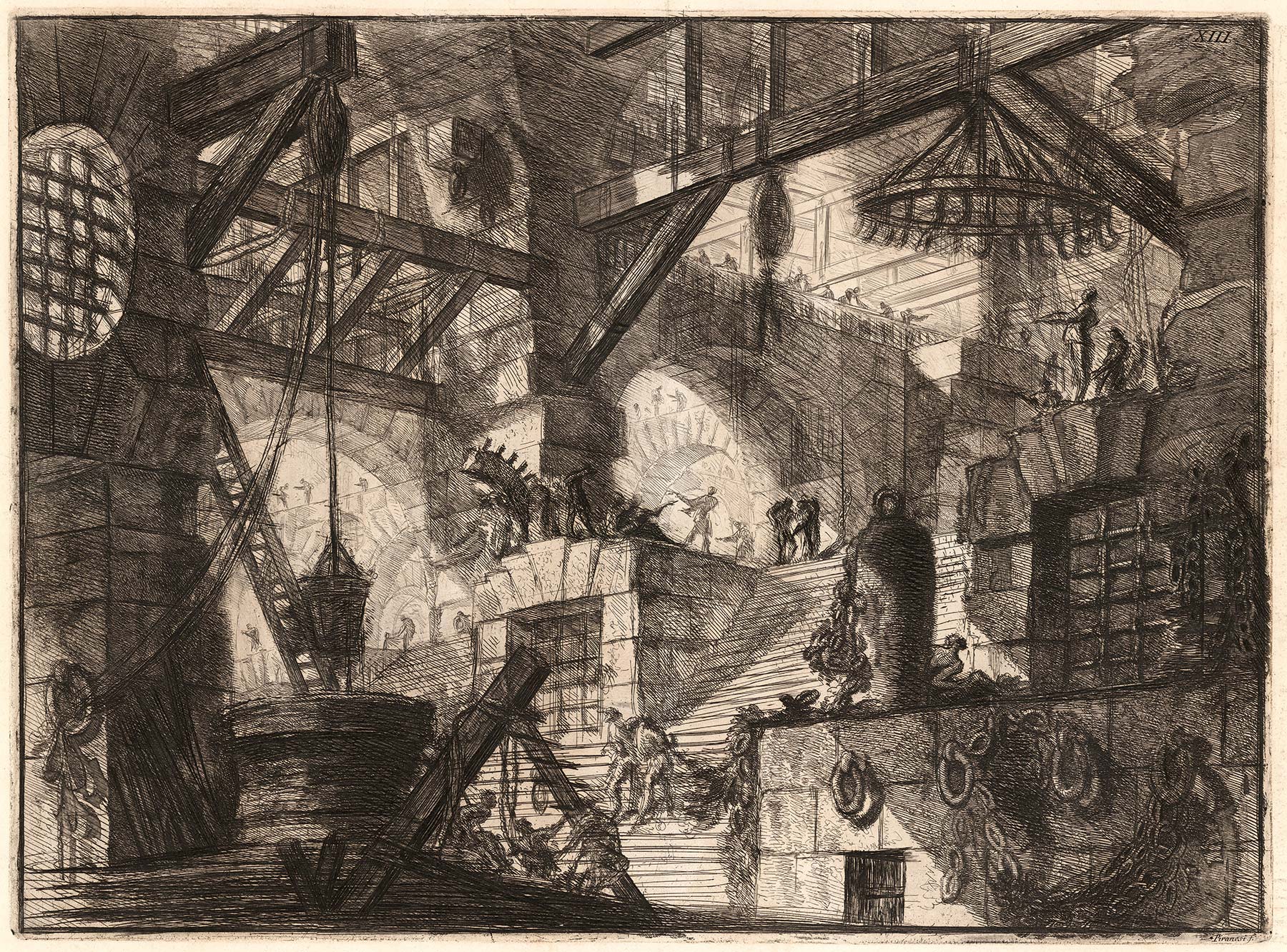
“The Well,” 1761
Plate 13 from Carceri d’invenzione [Imaginary Prisons]
Etching and engraving on paper
Image: 16 3/16 x 22 1/16 inches (41.1 x 56 cm)
Purchase with funds provided by the Memorial Art Fund, 2024.028
Click or tap image to enlarge
The figures on the central landing give orders while others kneel at their feet. Below, a prisoner is splayed out, one arm tied to a frame, while another cowers behind a pillar on the platform above, both tortured by the men handling the chains.
Piranesi’s reworking of the plate created a darker mood. Watery marks appear throughout suggest the use of aquatint, a printing technique in which areas of a plate are textured by acid.
Elsa Marrian ’25