Interest in Ancient Rome predates Piranesi’s time by centuries. Already during the Middle Ages and, especially, the Renaissance antiquarianism, a profound interest in Classical Antiquity had become prominent. During the eighteenth century, however, Rome became a major destination for antiquarians and curious tourists eager to take in the sights of the city.
Upon his arrival in Rome in 1740, Piranesi apprenticed with Giuseppe Vasi (1710–1782), a printmaker who provided guidebooks with small views of ancient and modern Rome. Honing his printmaking skills and deepening his passion for Ancient Rome, he blended his interest in the antique and the picturesque.
Driven by his antiquarian zeal and artistic ambition, Piranesi became the ultimate preserver of Rome’s ruins. Before long, his prints transcended mere antiquarian documentation, presenting ancient remains in a compelling dialogue between antiquity and the present.
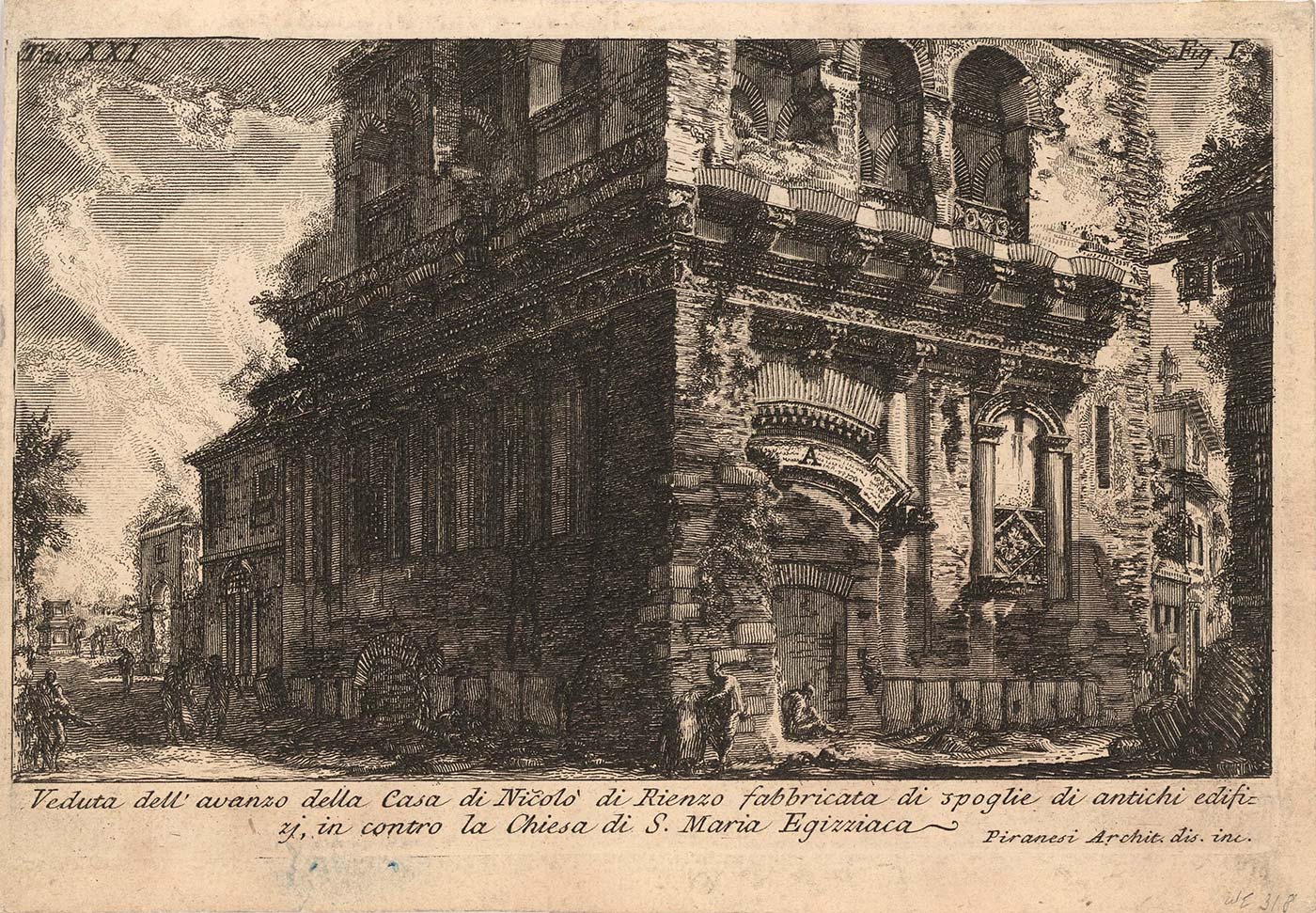
Veduta dell’avanzo della Casa di Nicolò di Rienzo … [View of the Ruins of the House of Nicolo di Rienzo …], 1756
Plate 21 from Le Antichità romane [The Roman Antiquities], vol. 1
Etching on paper
Image: 5 1/2 x 8 5/8 inches (14 x 21.9 cm)
Purchase with funds provided by Jane and Raphael Bernstein
Click or tap image to enlarge
Built from ancient spolia—reclaimed building materials—the structure featured in this print embodies Rome’s long history of adaptation and reuse. The inscription above the house’s entrance, labeled “A” in the print, speaks to the builder’s antiquarian intention: “it was not vanity which provided motivation to build this house, but the desire to restore the ancient dignity of Rome.”
Piranesi transforms the twelfth-century structure that he identifies as the House of Nicolò di Rienzo (now called the House of the Crescenzi) into a historical icon by stressing the incorporation of the ancient spolia.
Nick Anderson ’26
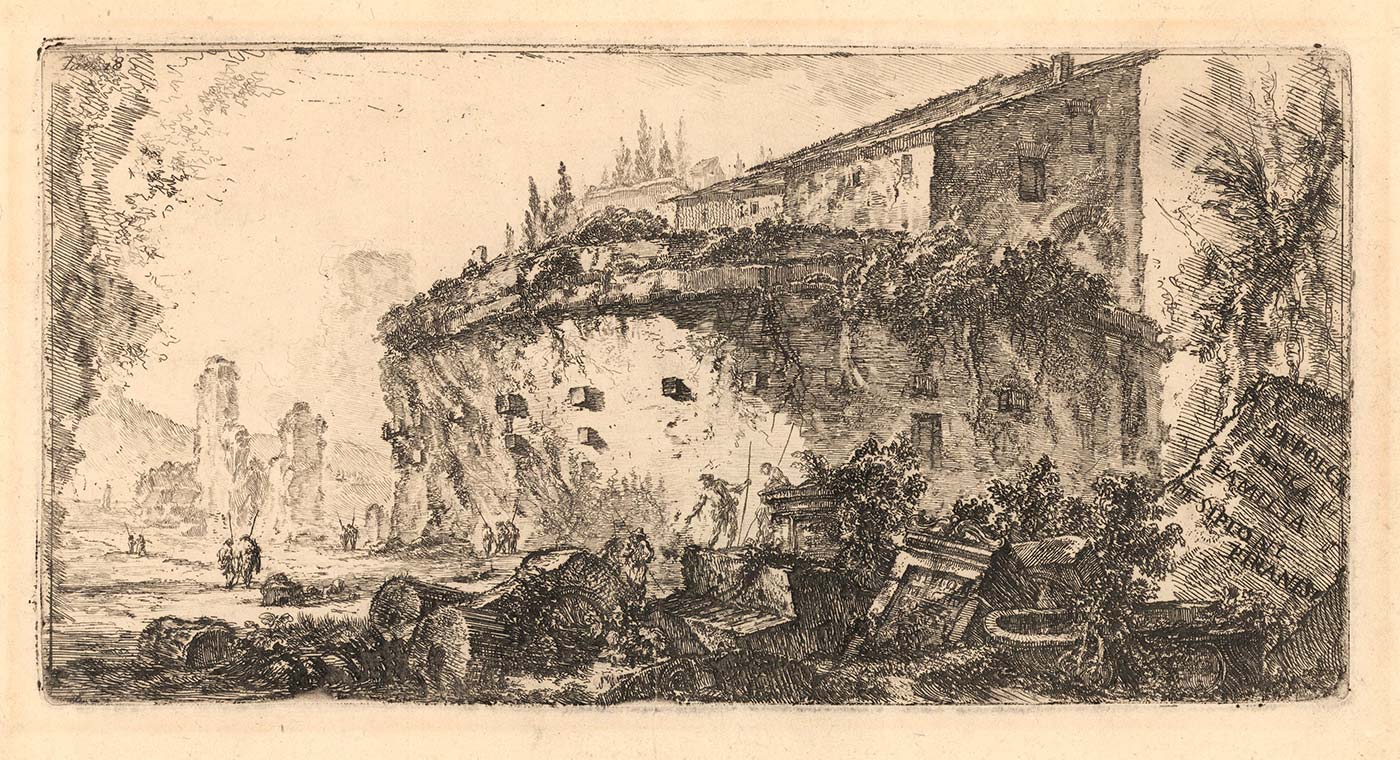
Sepolcro della famiglia de’Scipioni [Tomb of the Family of the Scipios], 1748
Plate 18 from Alcune Vedute di Archi Trionfali … [Some Views of Triumphal Arches …]
Etching on paper
Image: 5 3/8 x 10 3/4 inches (13.7 x 27.3 cm)
Gift of Thomas J. McCormick, 1969.004
Click or tap image to enlarge
In this picturesque print, Piranesi identifies an ancient rotunda along the Via Appia south of Rome as the tomb of the Scipios, a prominent Late Republican family. Today, it is known as the Casal rotondo, an anonymous mausoleum from the Early Roman Imperial Period.
Framed between twisting volumes of vegetation, the round ruin sits bathed by an oblique ray of light. Architectural fragments scattered throughout the foreground suggest dilapidation and quietude. The structure looms over the small human figures, who provide a sense of exaggerated scale.
Sofia Marcktell ’27