In eighteenth-century Italy, paper for prints was generally made from linen or cotton rags, soaked in water and beaten to break down the fibers. The resulting pulp was then spread onto a wire mesh, pressed between felt blankets to remove excess water, and hung up to dry. Watermarks identified the paper maker.
Piranesi primarily used etching for his prints. Using an etching needle, he inscribed his images onto wax-coated copper plates, exposing the metal. The plates were then submerged in acid to etch the lines into the plates. The wax removed, the plates were inked and wiped, allowing the etched lines to retain ink. The plate and a sheet of paper were then run through a press, transferring the ink onto the paper.
In 1752 Piranesi married Angela Pasquini. He used her dowry to invest in copper plates for his printmaking operation. Over the course of his career, he often reworked these plates, resulting in states that differed from each other. Early impressions and early states are usually most valued.
Piranesi also experimented with various printing procedures. For instance, he sometimes engraved directly onto the plate or brushed acid directly on the copper plates. Sometimes he would leave a thin film of ink on the unetched parts of the plate, creating a subtle off-white hue in the print called “plate tone.”
After Piranesi’s death in 1778, his son Francesco continued the printing business. In 1799, Francesco and his brother Pietro moved the business, plates and all, to Paris. The plates were sold to the brothers Firmin-Didot in 1807. In 1839, they were bought by the Vatican and returned to Rome. In 1870 they moved, once again, to the Regia Calcografia of the new Italian state, the prints made there embossed with a relief stamp. After 1945, the Calcografia Nazionale obtained the plates. Prints continued to be issued into the twentieth century.
While many prints in this exhibition are in fine condition, others have darkened or been damaged over the years. Several have been conserved by a paper specialist who removed water stains, mended small tears, and flattened folds.
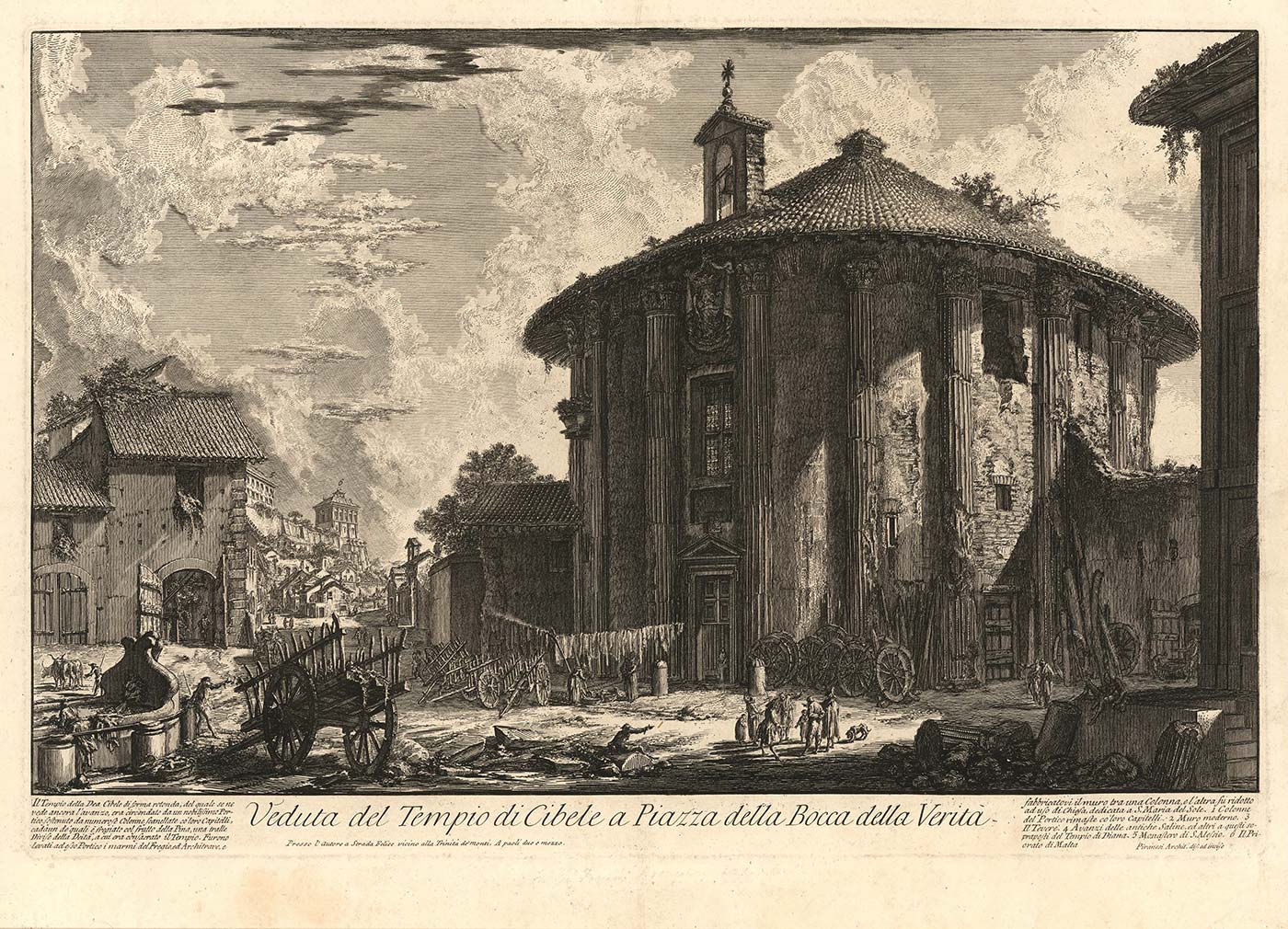
Veduta del Tempio di Cibele a Piazza della Bocca della Verità [View of the Temple of Cybele in the Piazza of the Bocca della Verità], 1758
Etching on paper
Image: 15 3/4 x 23 1/2 inches (40 x 59.7 cm)
Purchase with funds provided by Jane and Raphael Bernstein
Click or tap image to enlarge
This urban scene features the quiet encroachment of history on the Ancient Roman temple that Piranesi claims was dedicated to the goddess Cybele. It is now generally identified as the temple of Hercules Victor. In the Middle Ages, the structure became a church dedicated to Saint Stephen “of the Carriages” and an intercolumnar wall was added, since long removed. By Piranesi’s time the building had become the church of Santa Maria del Sole.
Will Dyer ’27