The print series of the Ancient Greek temples at Paestum was Piranesi’s last project. He collaborated with his son Francesco who, after his father’s death finished the plates and published the prints.
The Paestum series is Piranesi’s only work exclusively devoted to Greek architecture. It could be seen as Piranesi conceding defeat in the Greece v. Rome debate. In truth, he saw the Greek forms as stark, noting that they did not conform to the rigid norms of Greek architecture as prescribed in the ancient sources. The images of the overgrown ruins also hint at Piranesi’s romantic notion that, in the end, nature would reclaim all culture.
Piranesi’s monumental prints of the temples at Paestum rank among the most striking images of Ancient Greek architecture ever made.
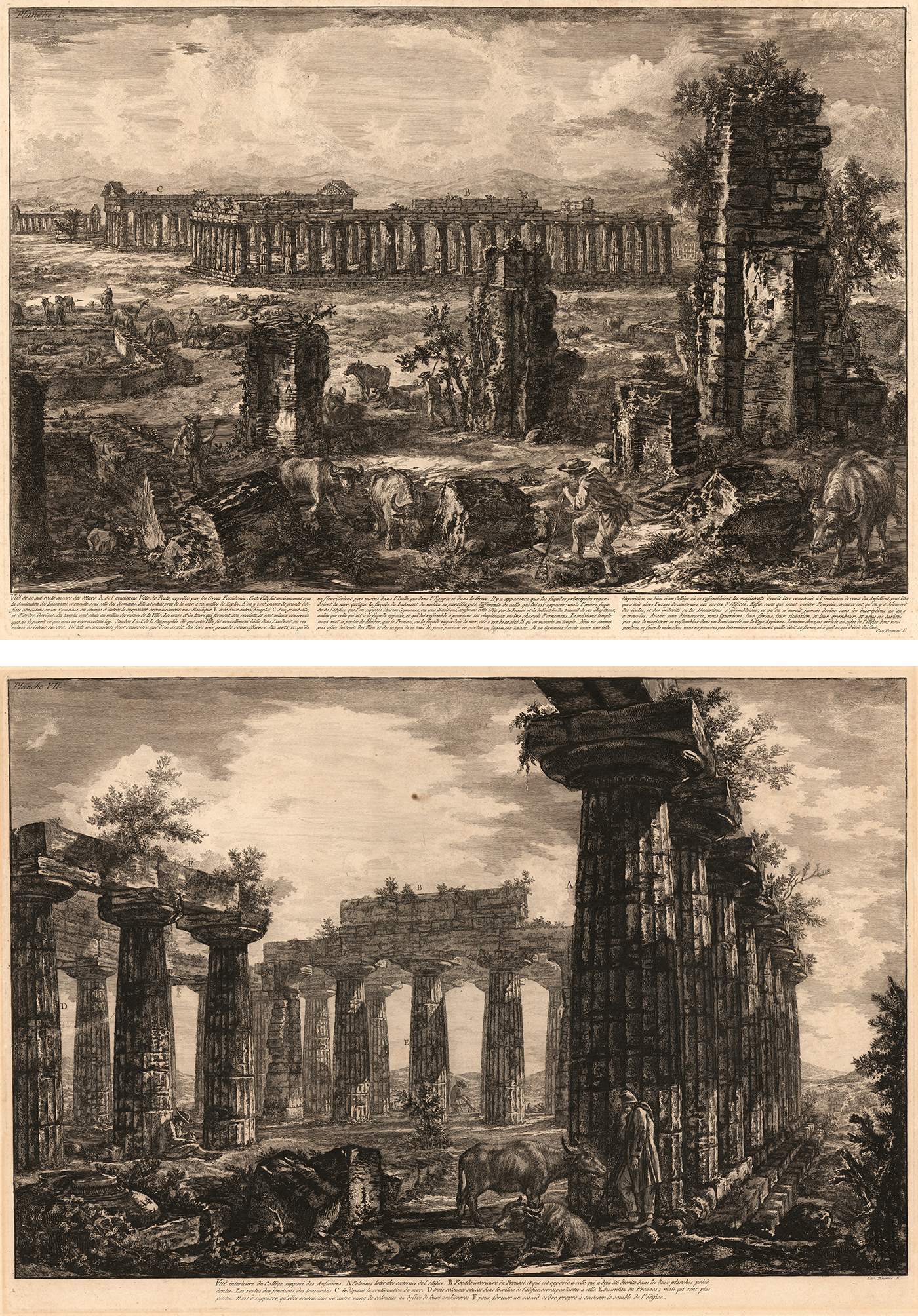
Vue de ce qui reste encore des Murs de l’ancienne Ville de Pesto … [View of the Remains of the Walls of the Ancient City of Paestum …], 1778
From Différentes vues … de Pesto [Various Views … of Paestum]
Etching on paper
Image: 19 1/8 x 27 inches (48.6 x 68.6 cm)
Gift of Cecil A. Howard, 1979.030
Vue interieure du Collège supposé des Anfictions [Interior View of the So-Called College of the Amphictyons], 1778
From Différentes vues … de Pesto [Various Views … of Paestum]
Etching on paper
Image: 19 1/2 x 27 1/4 inches (49.5 x 69.2 cm)
Gift of Cecil A. Howard, 1979.023
Click or tap image to enlarge
In the top print, cattle and cowherds wander about, oblivious to the decaying ruins. Piranesi identifies the structures as the College of the Anfictions (now the Temple of Hera I), the Temple of Poseidon (now the Temple of Hera II), and the Temple of Ceres (now the Temple of Athena).
The bottom print of the Temple of Hera I, features figures roaming about the overgrown remains, Piranesi seems to invite us to embrace nature’s inevitable reclamation of human achievement.
Jude Kuykendall ’28