An extended trip across Europe became an important rite of passage for the European upper classes, notably young English aristocrats, during the eighteenth-century. On this “Grand Tour,” Rome was their ultimate destination.
Piranesi catered to the Grand Tourists who acquired his prints as souvenirs of Rome. In addition to prints, especially his Vedute di Roma [Views of Rome], he also sold antiquities from a “museo” in his shop.
Piranesi’s prints were particularly celebrated for their level of detail and ability to represent Rome, both ancient and modern. Cognizant of this, Piranesi befriended many Grand Tourists, becoming well-known in learned society across Europe.
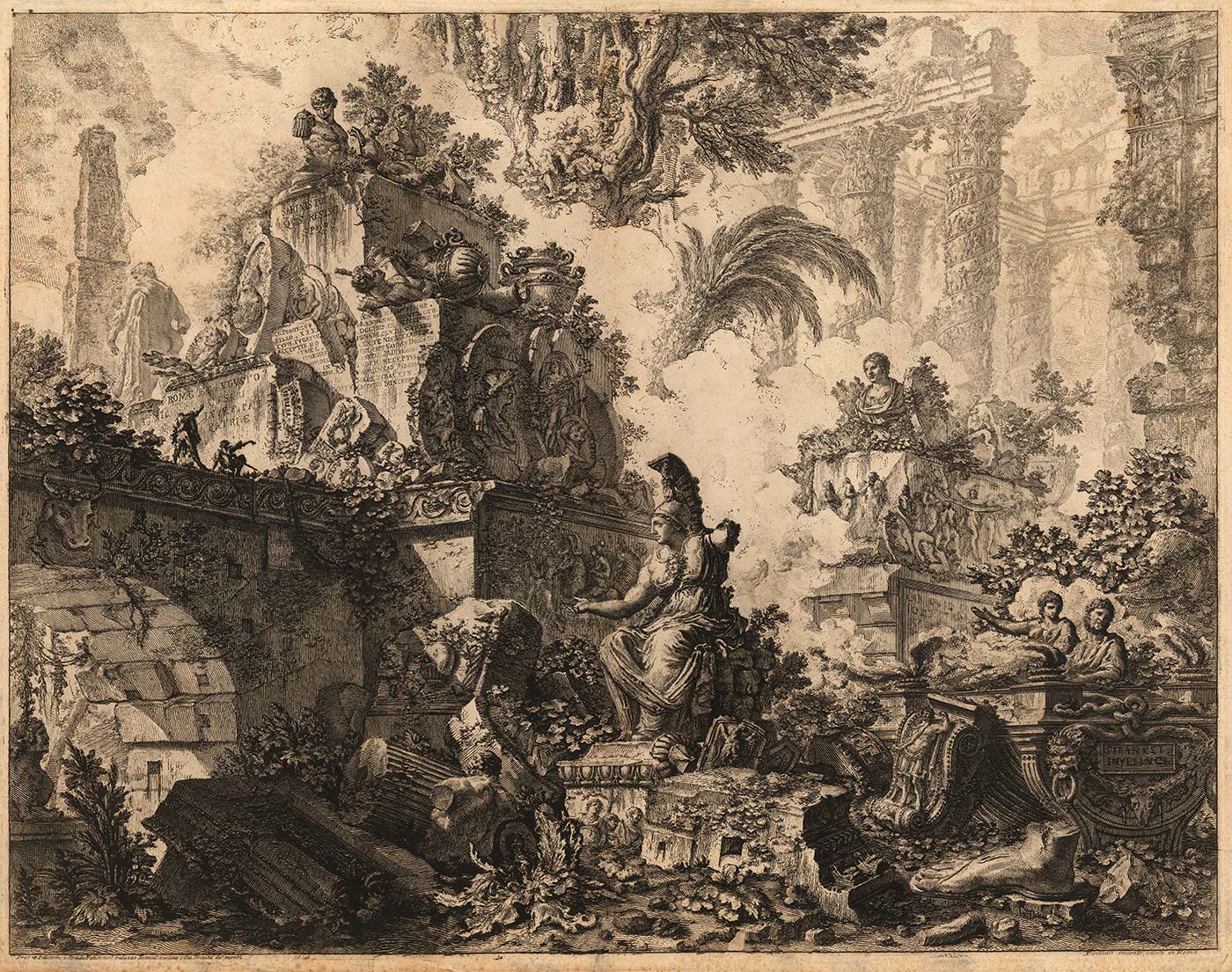
Fantasy of Ruins with a Statue of Minerva, c. 1748
Frontispiece of Vedute di Roma [Views of Rome], vol. 2
Etching on paper
Image: 20 x 25 1/2 inches (50.8 x 64.8 cm)
Gift of Mr. and Mrs. Lawson Stewart, 1993.010
Click or tap image to enlarge
Piranesi’s introductory print to the second volume of his Vedute di Roma [Views of Rome] depicts a statue of Minerva, the Roman goddess of wisdom and warfare, at the center of archaeological remains. On the left an arched bridge abuts a stack of inscribed blocks. It casts a dramatic shadow over column shafts, entablature blocks, and figural friezes strewn about below. On the right a sculptural group evokes a funerary monument. The background features a ruined colonnade and more sculptures.
Piranesi invites us to reflect on the enduring relevance of Rome’s heritage, even as the vegetation throughout adds a sense of decay.
Ariana Troutman ’27
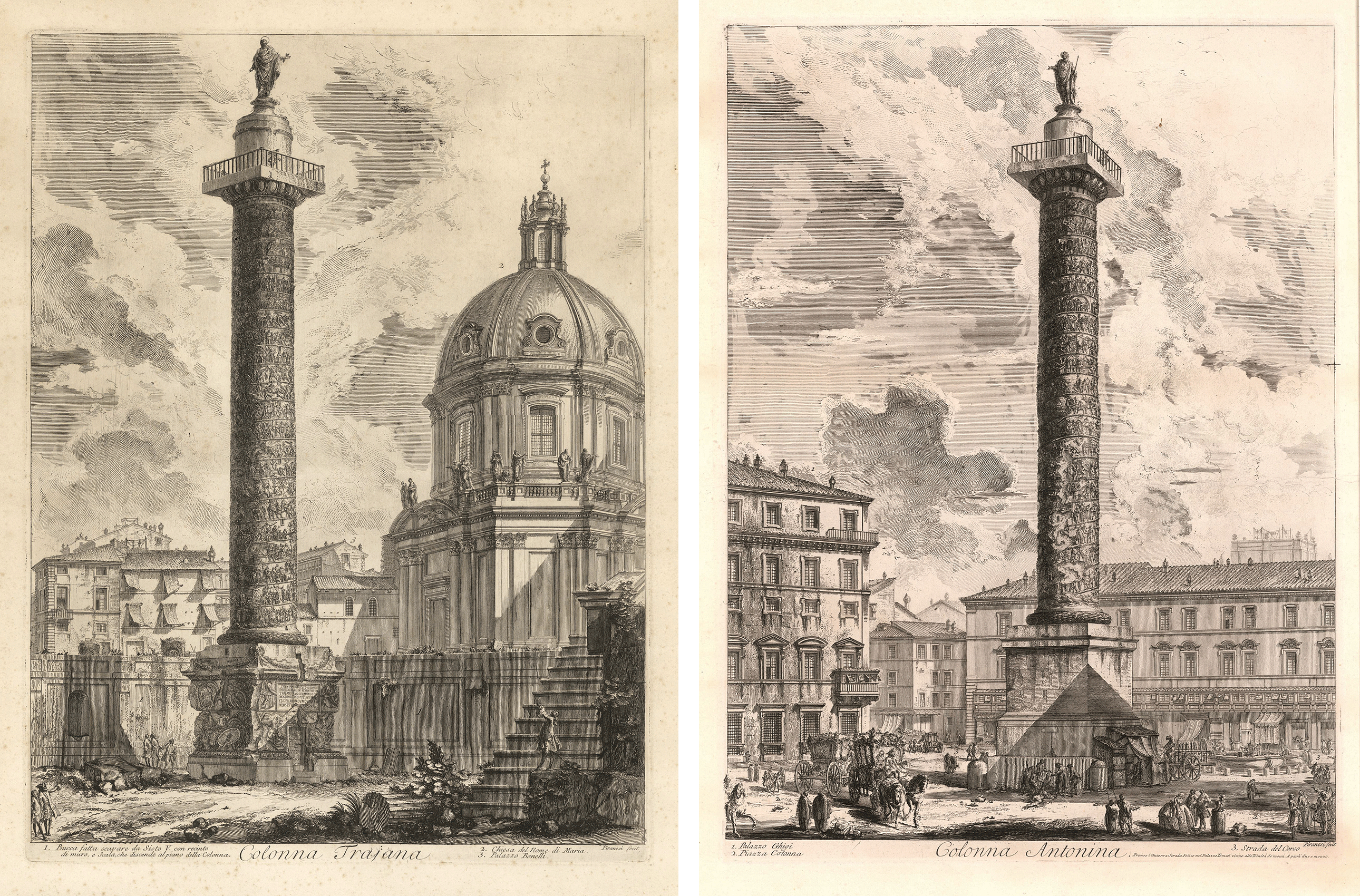
Colonna Trajana [Trajan’s Column], 1758
Etching on paper
Image: 21 1/4 x 16 inches (54 x 40.6 cm)
Colonna Antonina [Column of Marcus Aurelius], 1758
Etching on paper
Image: 21 7/8 x 15 7/8 inches (55.6 x 40.3 cm)
Purchase with funds provided by Jane and Raphael Bernstein
Click or tap image to enlarge
The columns of Trajan and Marcus Aurelius were must-see destinations for Grand Tourists, who are depicted visiting the monuments.
To the left of Trajan’s Column, a guide extolls the monument’s virtues while his disinterested charge engages our attention. A man on the steps calls to his friend atop the column, highlighting the structure’s enormous size. In the Column of Marcus Aurelius print, Piranesi accentuates the monument’s lofty presence by contrasting it with an urban environment.
Tyler Pincelli ’28 and Ariana Troutman ’27
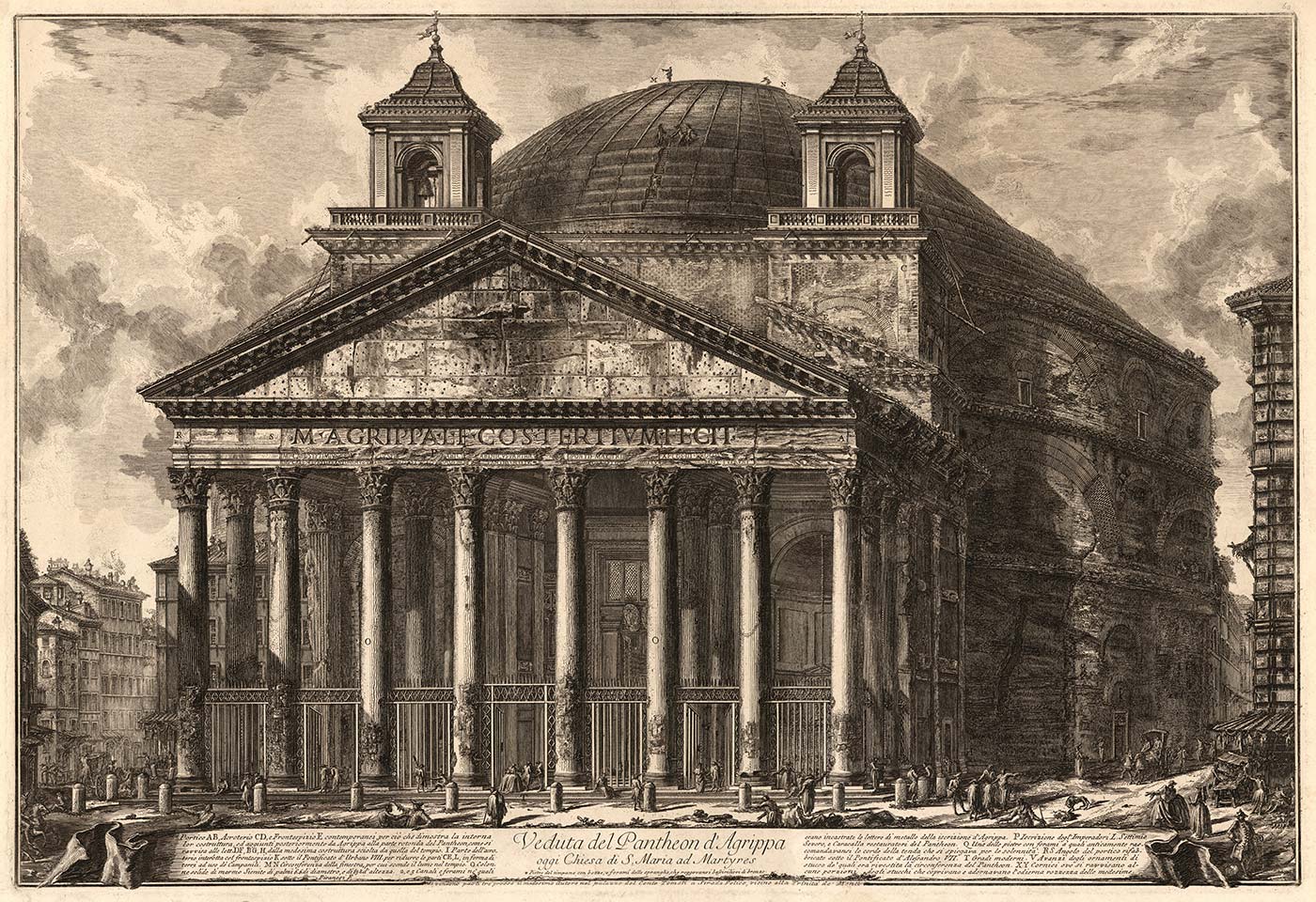
Veduta del Pantheon d’Agrippa … [View of the Pantheon of Agrippa …], 1761
Etching on paper
Image: 18 3/4 x 27 5/8 inches (47.6 x 70.2 cm)
Gift of Cecil A. Howard, 1979.029
Click or tap image to enlarge
The Pantheon, one of the best-preserved Ancient Roman buildings, was constructed under emperors Trajan and Hadrian (ruled consecutively from 98 to 134 CE) as a rebuilding of its early-imperial predecessor, the Pantheon of Agrippa.
Piranesi depicts the Pantheon in a three-quarter view featuring the portico and the domed rotunda behind it. Figures populate the piazza, while others atop the dome exaggerate the building’s size. The seventeenth-century bell towers were removed in the nineteenth century.
Tyler Pincelli ’28
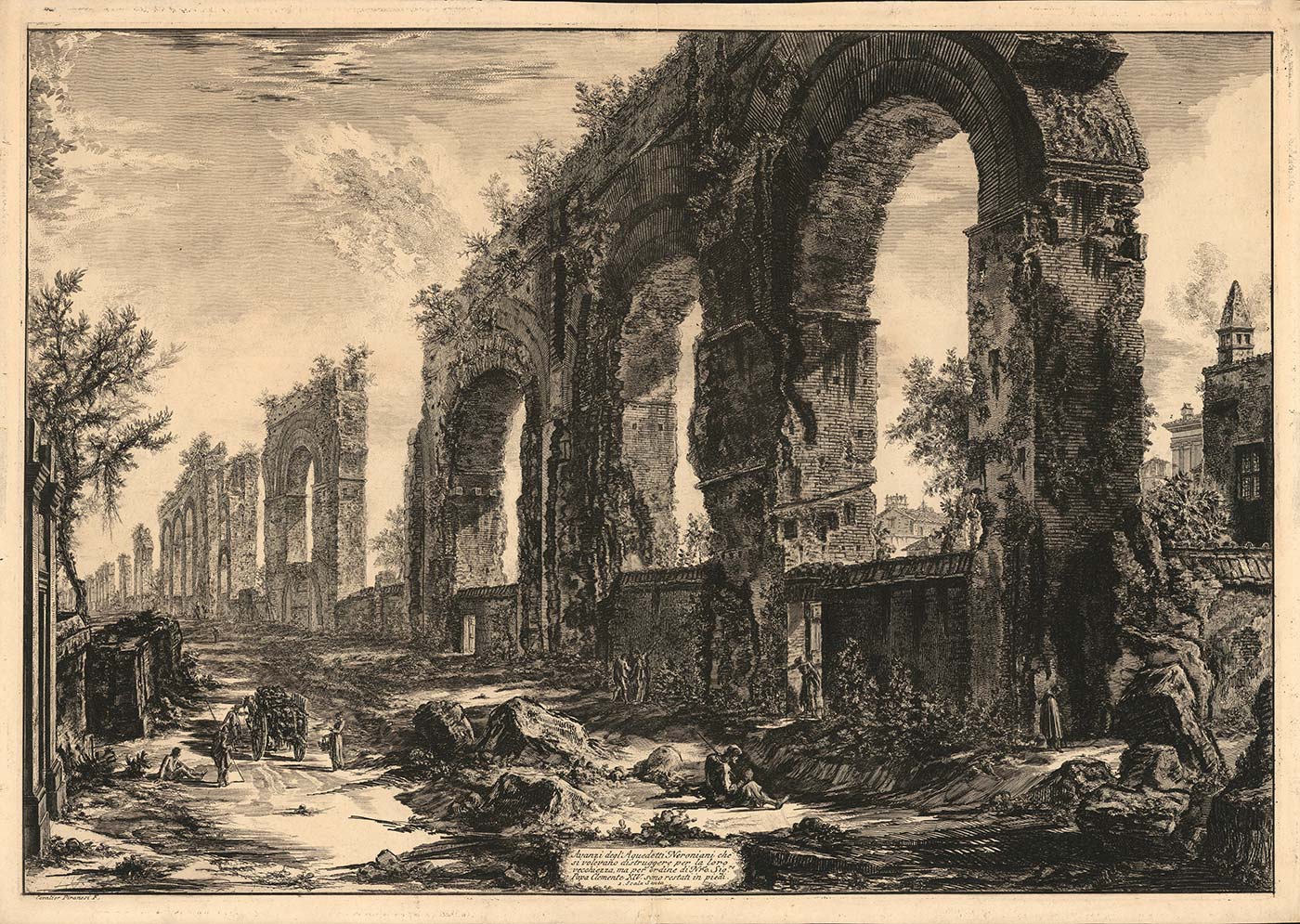
Avanzi degl’Aquedotti Neroniani … [Remains of the Neronian Aqueducts …], 1775
Etching on paper
Image: 19 1/4 x 27 3/4 inches (49.3 x 71.0 cm)
Purchase with funds provided by Jane and Raphael Bernstein
Click or tap image to enlarge
Piranesi also recorded Roman infrastructure, as with this majestic stretch of aqueduct. Its remains become darker and larger from left to right, creating a dramatic, looming perspective, in keeping with contemporary taste for sublime experiences.
Below, Piranesi recognizes Pope Clement XIV for sparing the ruins from demolition. He also references the Scala Santa, the twenty-eight stairs upon which Christ supposedly walked to face Pilate, installed in the San Lorenzo Chapel, just visible on the right.
Maya Dolan ’28
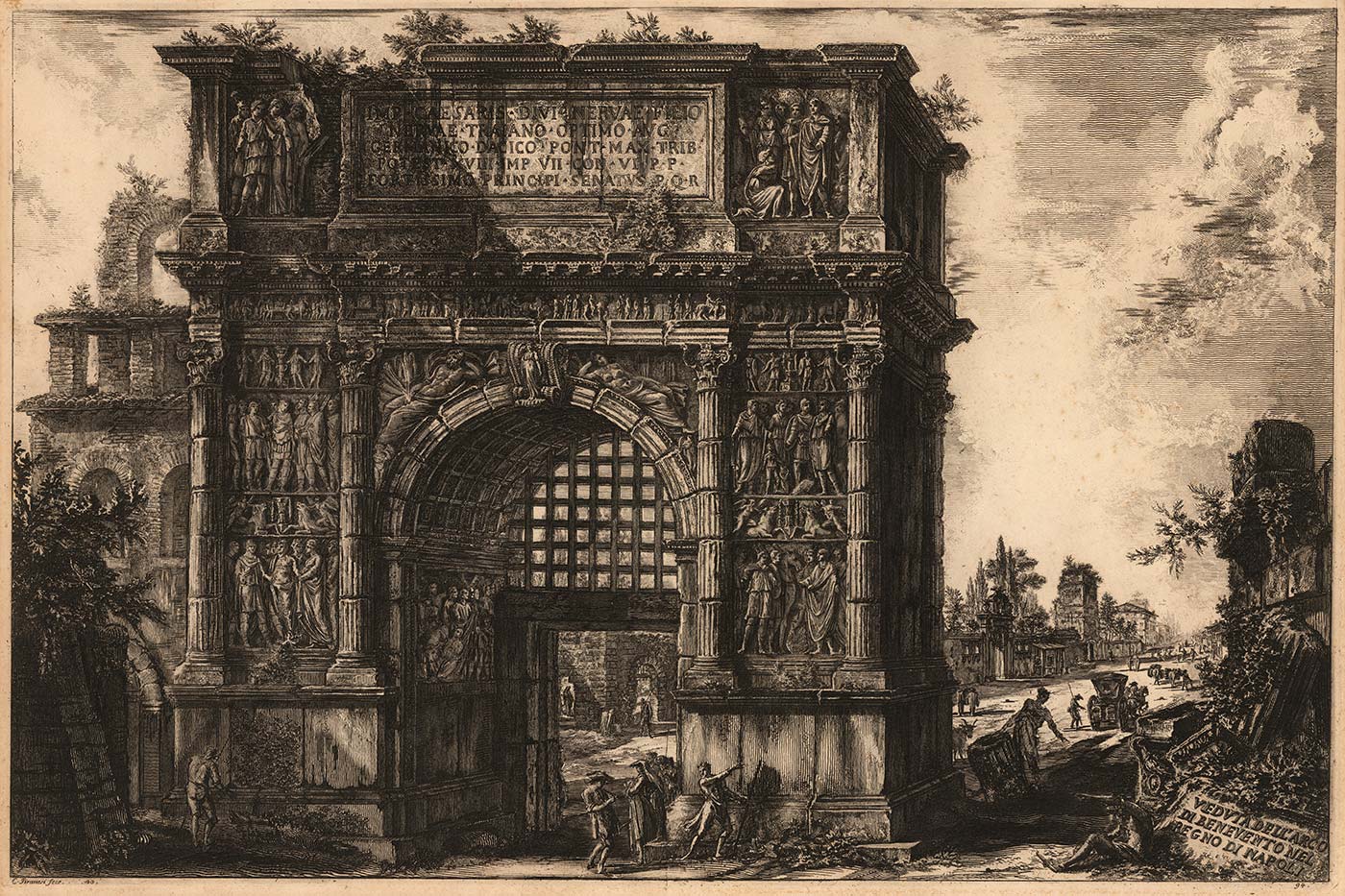
Veduta dell’Arco di Benevento … [View of the Arch of Benevento …], 1778
Etching on paper
Image: 18 3/4 x 28 1/4 inches (47.6 x 71.8 cm)
Gift of Mr. and Mrs. Lawson Stewart, 1993.013
Click or tap image to enlarge
This print of the Arch at Benevento near Naples, Italy, is among the few Vedute di Roma that depict a site far from the city. Erected between 114 and 117 along the Via Appia, it commemorated Emperor Trajan’s victories in Dacia and Mesopotamia.
Piranesi captures the monument’s grandeur yet blends the majesty of Rome’s past with nature’s subtle reclamation. Bustling figures carry on with their daily lives, highlighting the casual coexistence of past and present.
Jude Kuykendall ’28
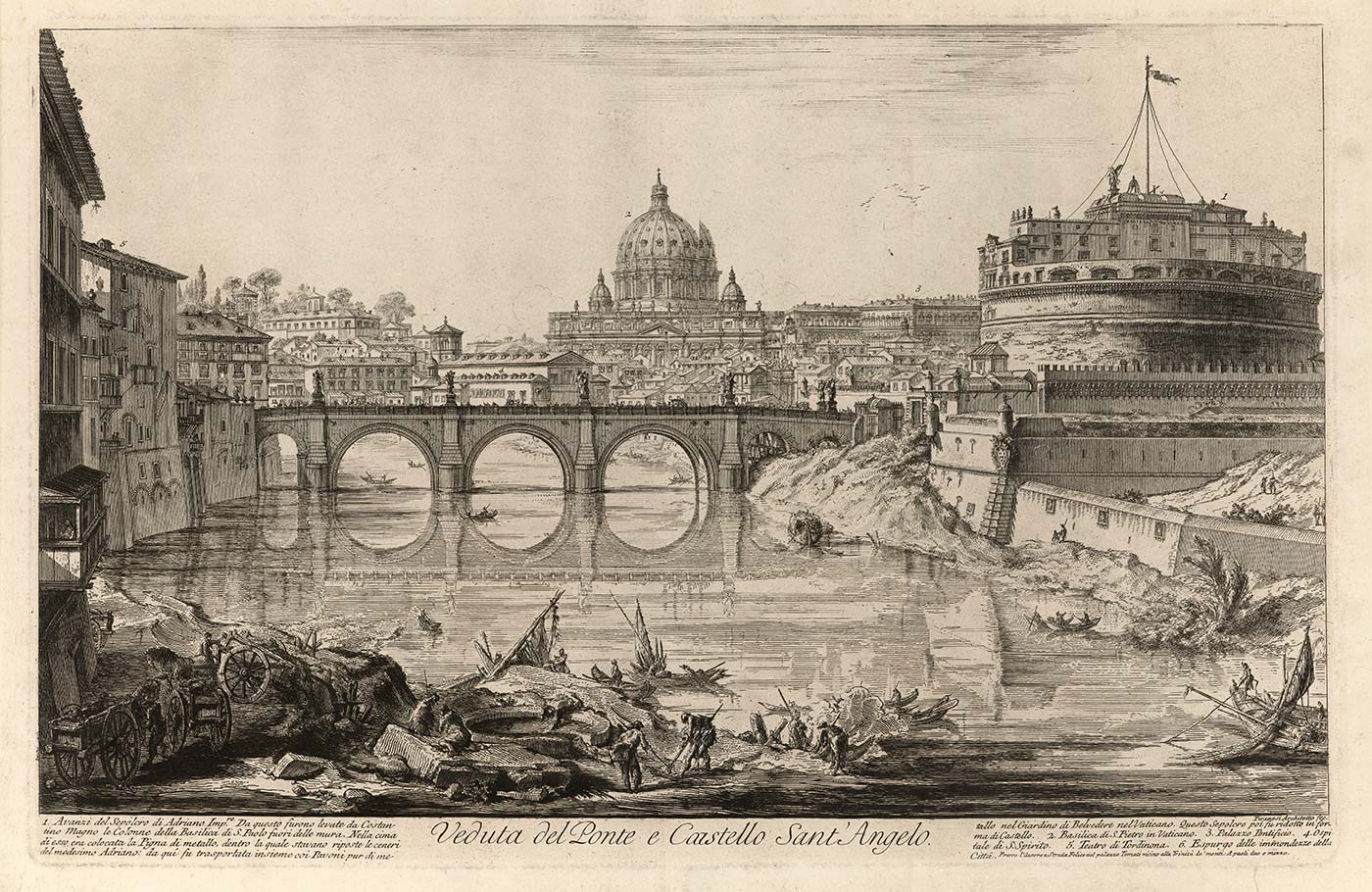
Veduta del Ponte e Castello Sant’Angelo [View of the Bridge and Fortress of Sant’Angelo], 1754
Etching on paper
Image: 15 1/8 x 23 1/4 inches (38.4 x 59.1 cm)
Museum purchase, 0.122
Click or tap image to enlarge
The Vedute di Roma also included prints of post-Antique Rome. Piranesi depicts the dome of Saint Peter’s Basilica rising above the bridge over the Tiber, framed by the Castel Sant’Angelo and dense urban fabric along the riverbank.
In addition to Saint Peter’s (2) and Castel Sant’Angelo (1), the text below references the pope’s palace (3), a hospital (4), a theatre (5), and workers transferring rubbish into river boats (6), effectively capturing Piranesi’s “modern” Rome.
Farren Stainton ’28
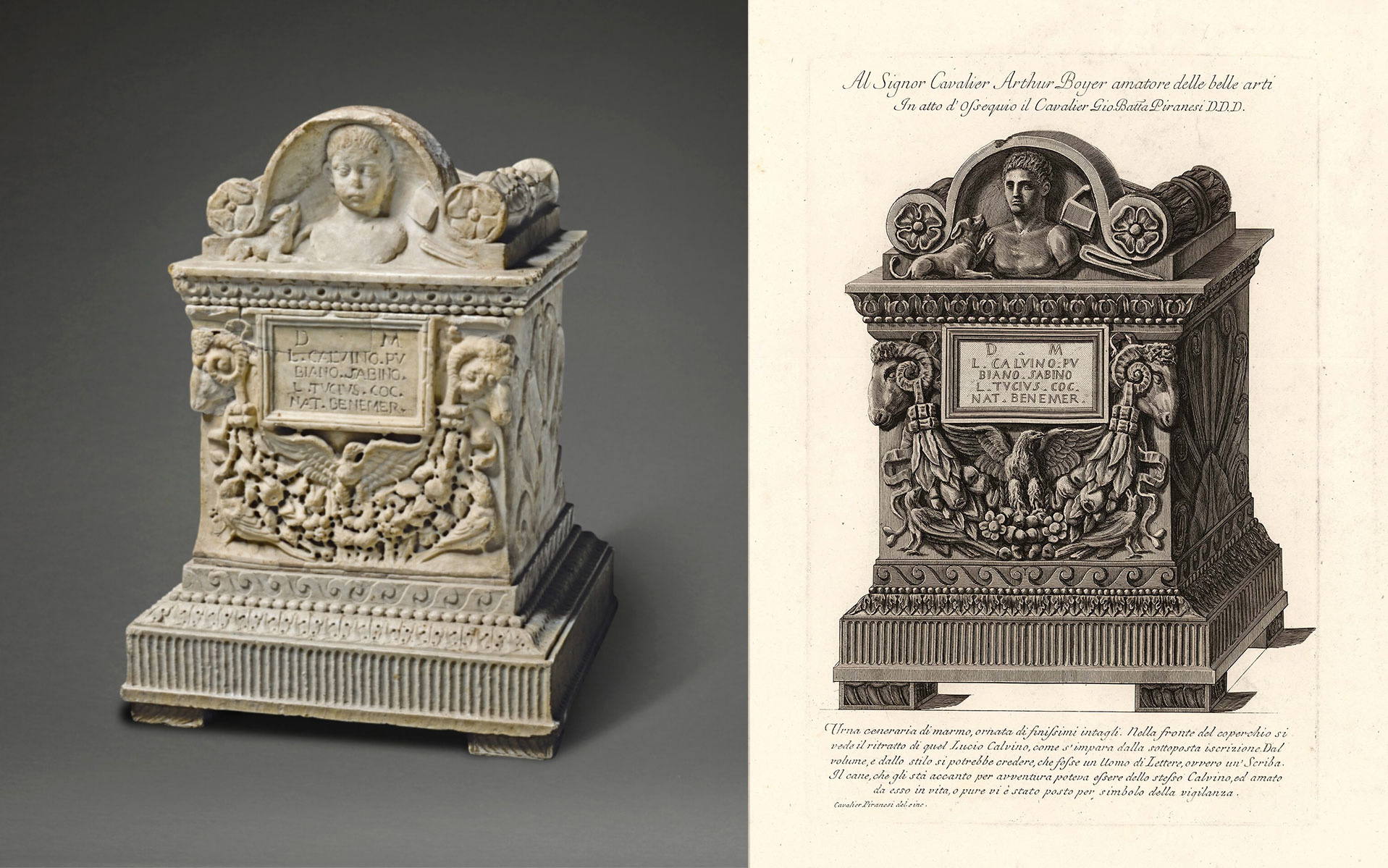
Ancient Roman Cinerary Urn
Late 1st century with 18th-century base
Restored and completed by Piranesi
Marble
19 5/16 x 13 3/4 x 13 1/8 inches (49 x 35 x 33.4 cm)
Purchase with funds provided by the Christian A. Johnson Memorial Art Acquisition Fund, 2023.013
Urna cineraria di marmo, ornata di finissimi intagli [Cinerary Urn in Marble, Decorated with the Finest Carvings], 1778
Plate 84 from Vasi, Candalabri … [Vases, Candalabras …], vol. 2
Etching on paper
Image (Cinerary): 15 3/8 x 10 1/4 inches (39.1 x 26 cm)
Purchase with funds provided by the Fine Arts Acquisition Fund, 2023.026
Click or tap image to enlarge
Grand Tourists could purchase antiquities from Piranesi’s “museo” for which he collected ancient fragments that he restored, modified, recombined, or augmented.
To complete this Roman cinerary box, Piranesi fitted a young boy’s funerary monument as its lid and provided a base of his own design. He added the inscription:
To the spirits of the departed—Lucius Tucius
Cocceius [made this] for Lucius Calvinus
Pubianus Sabinus, his well-deserving son.
Piranesi’s etching gave the resulting pastiche an air of authenticity.
Jude Kuykendall ’28