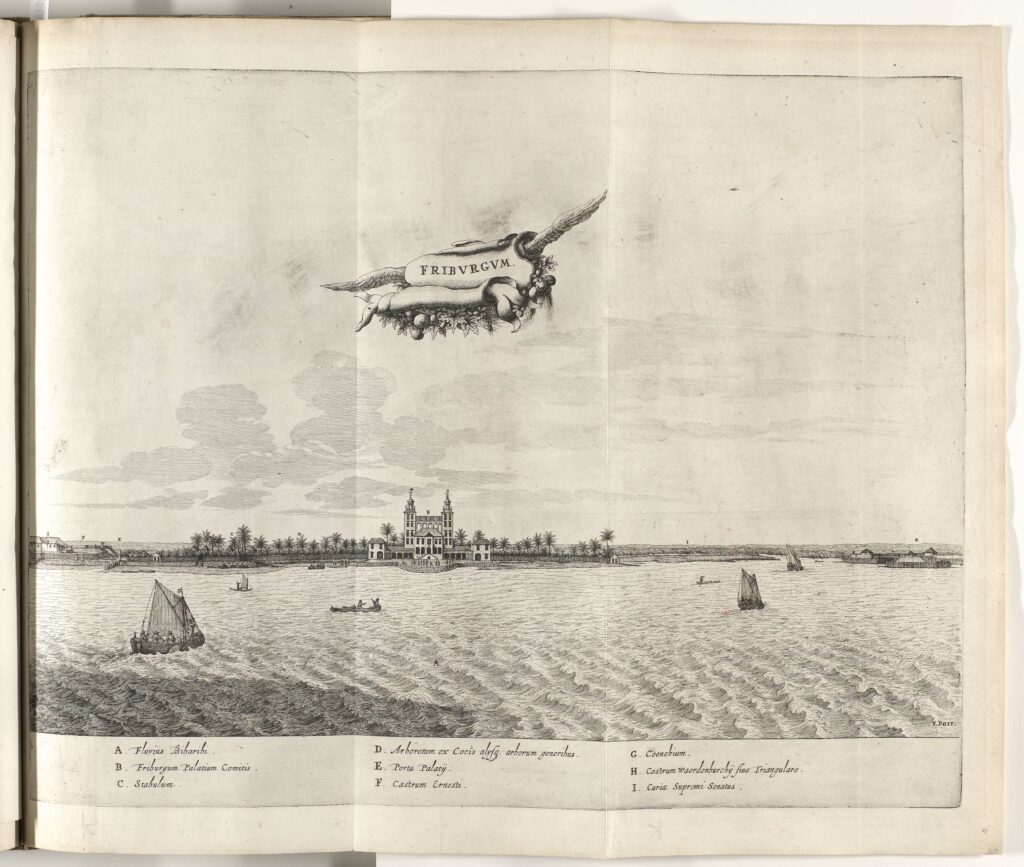
In the 17th century, the Dutch empire was expanding across the world, brutally colonizing and exploiting the land and people in Africa, Asia, and the Americas. At this time, prints were used as a source of information and followed the spread of the empire as a way of recording the colonial process and proving Dutch presence in the lands. Prints, however, are not objective works of art; they are created from the artist’s imagination and reflect their own world views. Prints were thus used to spread a Eurocentric, manipulated image of Dutch architecture in the colonized lands, which served to assert Dutch dominance and reinforce the empire’s claim over invaded areas.
In their colonies in the East Indies, the Dutch attempted to emulate the architecture of the Netherlands and built simplified townhouses. The primary manipulation in engravings created by Dutch artists of those colonized lands was the exaggeration of the Dutch architectural presence. As art historians such as Marsely Kehoe have argued, the purpose of this approach was to claim the land as their own and to emphasize the strength of the empire at a time when it was actually losing control in the area. The images of these lands populated with Dutch architecture were effective, since they enforced in the minds of their citizens and other empires that the lands belonged to the Dutch, but they did not reflect reality. According to Hans Derks, these images and the Dutch East India’s colonization of the land “nurtured the astonishing arrogance and dangerous presumption of having the right… to claim large parts of a foreign world as their own property.”
A clear example of the altered architectural presence in prints can be seen in Frans Post’s engraving of the Vrijburg Palace in Brazil. In 1630, the Dutch occupied a small island in Brazil, which was ruled by Dutch Governor-General Johan Maurits after 1637. Maurits was fascinated with the natural world and was known for the houses and gardens that he constructed. One of these houses, the Vrijburg Palace, became a subject of Post’s artwork. The engraving of the Vrijburg Palace was based on the drawings of Post, who had lived in the palace at the invitation of Maurits. In Post’s engraving, the building is large and ornate and sits on the edge of a body of water. The print looks at the palace from the water and shows the building towering over the surrounding trees and buildings. The palace’s proportions in the print are clearly exaggerated; if the palace was truly that large, it would have completely dwarfed its surroundings. Showing the palace as towering over land that the Dutch had brutally invaded served as a reminder that the land and people now belonged to them. The overstated architectural presence of the Dutch in prints once again confirmed in the minds of the Dutch their right to occupy and physically alter foreign lands.
Written by Hannah Dorosin, edited by Simone Edgar Holmes
Bibliography
Boogaart, E. Van Den, H. R. Hoetink, P. J. P. Whitehead, and Johan Maurits. Johan Maurits Van Nassau-Siegen, 1604-1679: A Humanist Prince in Europe and Brazil: Essays on the Occasion of the Tercenary of His Death. The Hague: Johan Maurits Van Nassau Stichting, 1979.
Da Silva, Maria Angélica, and Melissa Mota Alcides. “Collecting and Framing the Wilderness: The Garden of Johan Maurits (1604-79) in North-East Brazil.” Garden History 30, no. 2 (2002): 153-76.
Derks, Hans. “Reflections,” In History of the Opium Problem: The Assault on the East, Ca. 1600-1950, 373-80. Leiden; Boston: Brill, 2012.
Kehoe, Marsely L. “Imaginary Gables: The Visual Culture of Dutch Architecture in the Indies.” Journal of Early Modern History 20, no. 5 (2016).
