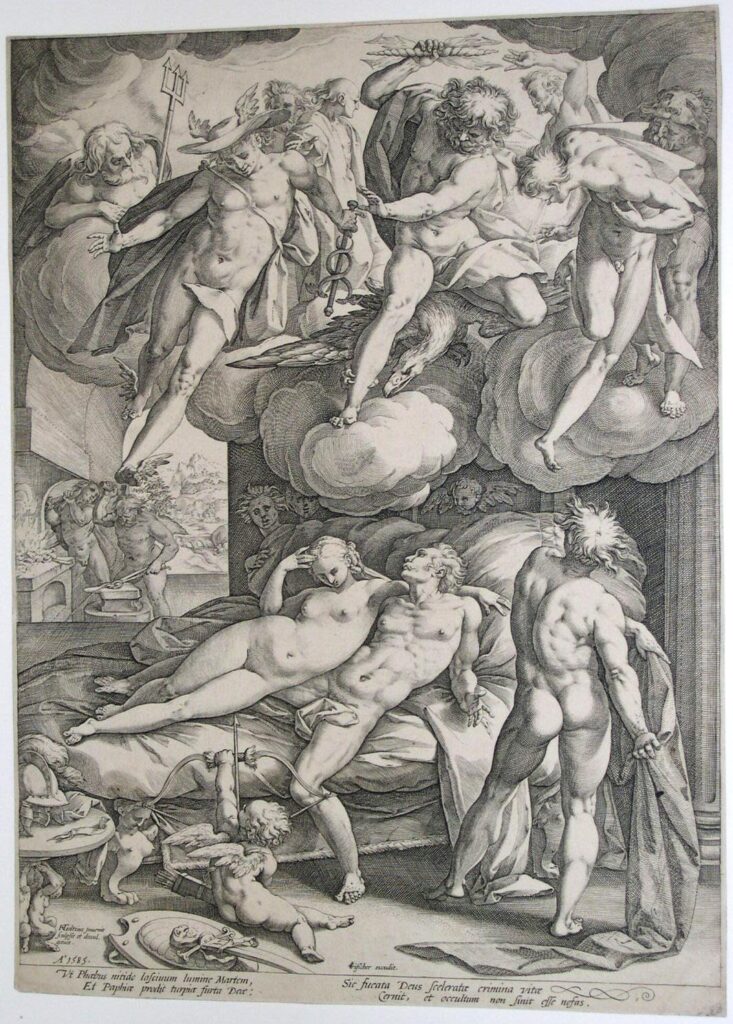
ARTIST: Hendrick Goltzius (Dutch, 1558 – 1617)
DATE: 1585
TECHNIQUE: Engraving
DIMENSIONS: Image: 41.6 x 30.8 cm, Paper Size: 55.8 x 71.1 cm
CREDIT LINE: Gift of Mr. and Mrs. Hugh M. Taft
OBJECT NUMBER: 1996.065
In his 1585 engraving Mars and Venus Surprised by Vulcan, Hendrick Goltzius uses exaggerated and unstable figures to develop drama and tension in his condemnatory scene of marital infidelity. Goltzius depicts Vulcan violently removing the sheets from a bed containing his wife, Venus, and her lover, Mars. Hovering over the bed, a group of other gods including Neptune, Mercury, Jupiter, and Apollo, charge into the bedroom to shame the adulterers. Contorted and convulsing, the gods above appear to be suspended mid-motion, their limbs and torsos twisted and curved into unnatural positions. The extended legs of Mercury, Jupiter, and Apollo point diagonally at the same leftward slant, which Goltzius highlights by placing the vertical edge of a doorway just behind Mercury’s angled leg. In the bottom right, Vulcan appears similarly twisted, with exaggerated back and leg muscles that Goltzius emphasizes by darkening the shadows in the contours of the god’s body. Overall, the writhing, unstable figures occupy most of the space of the print, encouraging the viewer to acknowledge the scene holistically without focusing upon individual characters or images.
This aim to develop the broad intensity of a scene is one of the defining characteristics of Goltzius’ classical prints. His other works of classical mythology, including Apollo and Coronis (1585) and Perseus and Andromeda (1583), show a similar deemphasis of specific characters to instead encapsulate his scenes in sweeping dramatic and climactic tones. Dutch contemporaries of Goltzius such as Joachim Wtewael (1566 – 1638) created classical works with far more focus on individual protagonists. Wtewael painted a similar scene, also titled Mars and Venus Surprised by Vulcan (1604–1608), that accentuates the personal intimacy between Venus and Mars. In contrast to Goltzius’s method of crowding the interloping gods around the couple, Wtewael separates the other figures from the lovers. As a result, Venus and Mars become the focus of Wtewael’s painting, with less emphasis on the intensity of the broader scene.
The seriousness and drama of Goltzius’ print conveys a tone of disapproval regarding the Venus and Mars’ adultery. In contrast to the domineering and exaggeratedly active figures of Vulcan and the interloping gods, Venus and Mars are depicted in passive and weaker positions, indicating that the lovers have been defeated; Vulcan, the victim of the adultery, has won by exposing their deception. As Lee Hendrix argues, Goltzius’ print “works to unmask and expose the deceitfulness underlying [the Olympians’] physicality, by taking the form of a monumental depiction of one of the most infamous [examples] of marital infidelity.” Thus, Goltzius’ use of passive figures for Venus and Mars serves to condemn their scandalous acts of adultery, while the exaggerated and active figures that represent the remaining gods encourage the viewer to acknowledge the holistic intensity of the scene, underscoring the seriousness of the infidelity.
Written by Tobias Ziemke, edited by Simone Edgar Holmes
Bibliography
Hendrix, Lee. “Conquering Illusion: Bartholomeus Spranger’s influence in Venus and Mars Surprised by Vulcan by Hendrik Goltzius.” In Hendrik Goltzius and the Classical Tradition, 66-72. Los Angeles: Fisher Gallery of the University of Southern California, 1992.
Lowenthal, Anne W. Joachim Wtewael: Mars and Venus Surprised by Vulcan. Malibu: The J. Paul Getty Museum, 1995.
