
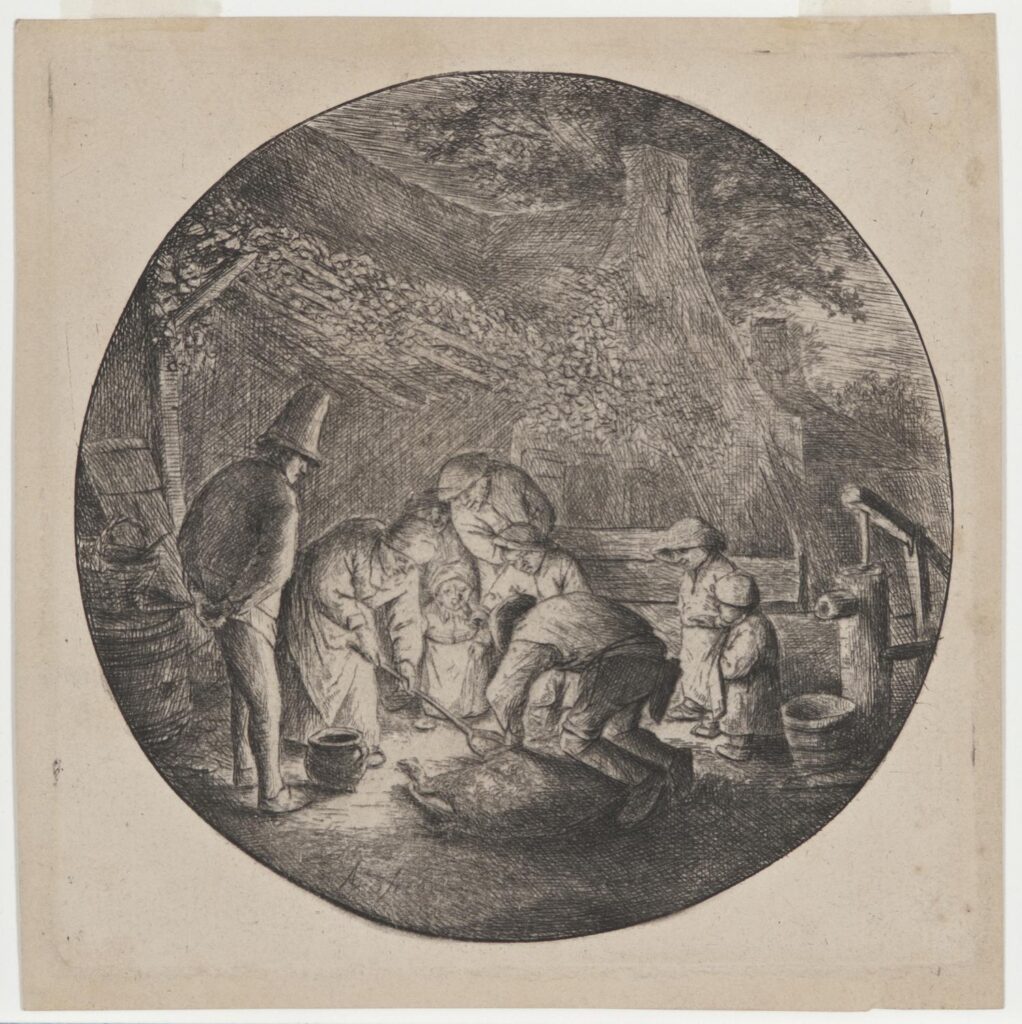
The Pig Killers or Peasants Slaughtering a Pig (Impression I)
ARTIST: Adriaen van Ostade (Dutch, 1610 – 1685)
DATE: c. 1645/printed 19th century
TECHNIQUE: Etching
DIMENSIONS: Image: 11.7 x 11.7 cm, Paper Size: 18.7 x 26.8 cm
STATE: VIII/VIII
CATALOGUE REFERENCE: Hollstein Dutch 41-5(8), Bartsch 41
CREDIT LINE: Gift of Egidio Moresi
OBJECT NUMBER: 1973.021
The Pig Killers or Peasants Slaughtering a Pig (Impression II)
ARTIST: Adriaen van Ostade (Dutch, 1610 – 1685)
DATE: c. 1645
TECHNIQUE: Etching
DIMENSIONS: Image: 11.7 x 11.7 cm, Paper Size: 18.7 x 26.8 cm
STATE: VIII/VIII
CATALOGUE REFERENCE: Hollstein Dutch 41-5(8), Bartsch 41
CREDIT LINE: Gift of John Hull Brown ’43 in memory of his wife Alice Cooke Brown ’35
OBJECT NUMBER: 1977.024
A family gathers in front of a rustic farmhouse with a thatched roof, watching the slaughtering of a pig in Adriaen van Ostade’s bluntly named print The Pig Killers. This chore was often completed in November to feed families such as this one during the long winter months. The central figures are illuminated by a young boy’s candle, which draws the viewer’s attention to the woman holding a ladle to catch the pig’s blood.
These brightly lit faces stand out against the surrounding darkness, an effect created by varying the distance between the etched lines. Van Ostade uses a dense, regular crosshatching pattern to build up nighttime shadows, leaving other areas of the plate unworked to suggest light, as can be seen in the young girl’s apron.
The shape of Van Ostade’s print is striking in its unique circularity, and the thickly outlined borders on these two impressions help identify them as the final state out of eight. In states one through three, the border is more lightly etched and discontinuous in parts. The rounded corners of the platemark, the impression left on the paper by the copper plate, also indicates that these impressions were printed after the fourth state. Finally, the pillar behind the tall-hatted man has a series of horizontal lines which are only included in eighth state impressions.
Van Ostade’s prints were highly desired even after his death, and publishers continued to make impressions well into the 19th century. Towards the end of the 18th century the French publisher Pierre Francois Basan (1723–1797) purchased the plates. After his death, his widow published an edition of van Ostade’s prints in the mid 19th century. The print donated to Middlebury College by Edigio Moresi in 1973 includes a modern-looking watermark on the paper, which also has no chain lines, marks of 17th-century papermaking techniques. However, the print given by John Hull Brown in 1977 does show authentic chain lines.
Written by Carrie Anderson, edited by Simone Edgar Holmes
Bibliography
Art Gallery NSW. “The pig killers.” Accessed July 16, 2020, https://www.artgallery.nsw.gov.au/collection/works/6724.39/.
Godefroy, Louis, Adriaen van Ostade, and Godefroy, Louis. The Complete Etchings of Adriaen Van Ostade: New Illustrations and First English Translation of the Catalogue Raisonné, Together with a Reprint of the Original French Edition. San Francisco: Alan Wofsy Fine Arts, 1990.
Ostade, Adriaen van, Peter van der Coelen, and Museum Het Rembrandthuis (Amsterdam, Netherlands). Everyday Life in Holland’s Golden Age: The Complete Etchings of Adriaen Van Ostade. Studies in Dutch Graphic Art, Vol. 3. Amsterdam: Museum Het Rembrandthuis, Rembrandt Information Centre, 1998.
